

Yes, you can wrap a car with scratches, but the wrap will not erase them. Cast wrap film is a few thousandths of an inch thick and follows the surface it sits on, so fine swirl marks usually disappear under it, while a scratch you can catch with a fingernail, a chip with a raised edge, or sun-faded clear coat tends to show through or cause trouble later. The paint underneath decides the result, which is why we look at it before anyone picks a color.
TL;DR
A car with scratches can be wrapped once the scratches are dealt with to the right depth. Light swirls and haze in the clear coat usually vanish under cast vinyl. Scratches deep enough to catch a fingernail, chips with lifted edges, peeling or chalky clear coat, and resprayed panels all show through the film or put the paint at risk when the wrap comes off.
Avery Dennison’s data sheet for its SW900 wrap film lists unclean or uneven surfaces, poor paint bond, and non-OEM paint among its unsuitable uses. In our shop, the usual order is paint correction first ($525, $675, or $825 by depth), then the wrap ($3,000 to $6,000 for a full car). Where the paint is too far gone for vinyl, Color PPF ($6,500 to $11,000, 10-year warranty) is the other route.
Will a Car Wrap Cover Scratches or Show Them?
A car wrap covers light scratches and shows deep ones. Avery Dennison’s SW900 film has a face film of 3.2 to 4.7 mil, with an adhesive layer of 1.2 mil under it.
That is thin enough to drape into a body line, which also means it drapes into a scratch, a chip crater or a ridge of failing clear coat. A wrap changes the color of a defect. It does not fill it.
What you see after the install depends on three things working together: how deep the defect goes, how the light hits that panel, and the finish you choose.
- Gloss film reflects like paint, so it shows everything under it the way paint would. A scratch that you notice on a black car in the sun will be there on a gloss blue wrap too.
- Satin and matte film scatter light and are kinder to fine marks. They still telegraph a ridge or a crater.
- Textured film such as carbon fiber hides the most, which is one reason it ends up on hoods and mirrors that have taken a beating.
That is trade knowledge from years of working with film, and it lines up with what the film makers print. The maker’s own sheet calls for a substrate that is clean and smooth, with “little or no variation in texture”. A scratch is a variation in texture.
So the honest answer to “will it hide my scratches” is a question back: which scratches?
Run the Fingernail Test Before Picking a Color
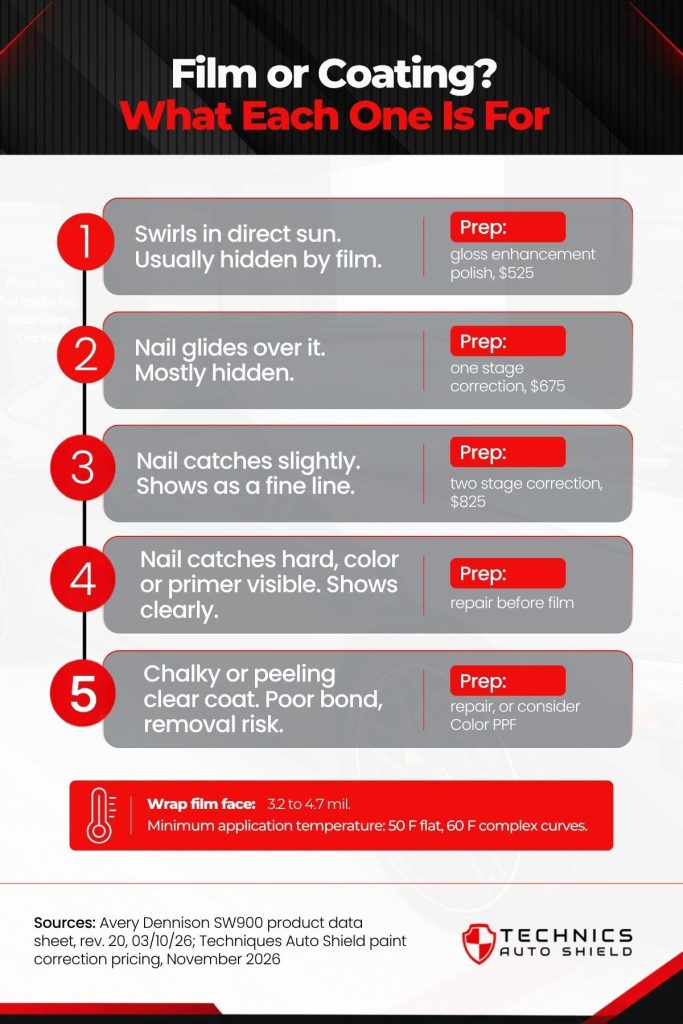
The quickest way to sort damage is the fingernail test. Run a fingernail across the scratch at a right angle. If the nail glides over it, the mark is almost always confined to the clear coat. If it catches, the scratch has probably gone through the clear coat into color, and possibly into primer.
It is a rule of thumb, not a measurement. Still, it predicts the outcome of a wrap better than any photo you can send us.
What you find | What it usually is | What a wrap does over it | What we normally do first |
|---|---|---|---|
Fine circles visible in direct sun | Wash swirls in the clear coat | Usually disappears under the film | Gloss enhancement polish or nothing |
Light lines, nail glides over them | Clear coat scratches | Mostly hidden, may ghost on gloss film | One-stage correction |
Nail catches slightly | Deeper clear coat damage | Shows as a fine line under the film | Two-stage correction, then a reassessment |
Nail catches hard, color or gray visible | Through to color or primer | Shows clearly, edge may lift on removal | Touch-up or panel repair before film |
Chip with a raised, flaking edge | Paint lifting from the panel | Bump under film; chip can pull out later | Edges dealt with before any film |
Chalky, whitish roof or hood | Oxidized or failing clear coat | Poor bond, removal risk | Assess the panel first, possibly not vinyl |
Most scratched cars we see carry two or three rows of that table at once. A daily driver might have wash swirls everywhere, a key scratch on one door and a sun-cooked roof. Each panel gets its own answer, and the quote follows the worst one on the car.
Parking lot damage versus aging damage
A door ding and a key scratch are local. They sit on otherwise healthy paint, so fixing them is a small, priced job before the wrap goes on. Fading and clear coat failure are different, because they usually cover a whole roof or hood, and they change what the film will bond to. Those two kinds of damage lead to very different conversations, and it helps to know which one you have before you call.
What Avery Dennison’s Data Sheet Rules Out
Wrap film makers publish where their product should not go, and that list is the most useful thing a scratched car owner can read. Avery Dennison’s SW900 Supreme Wrapping Film product data sheet (revision 20, dated 03/10/26) names these as unsuitable uses, among others:
- Paint that is not thoroughly cured or dried
- Surfaces that are not clean and smooth
- Painted surfaces with poor paint-to-substrate or paint-to-paint bond
- Non-OEM painted vehicles
- Film applied over pre-existing graphics without pre-approval
The same sheet then says what the maker will not stand behind at removal time. It does not warrant removability from surfaces with poor paint adhesion, improperly cured paint, or oxidized or chalked substrates. It also makes no warranty for removal from automotive paint more than 5 years old, and for aged paint it puts the testing and the liability on the user.
Read that list with a scratched car in mind and a pattern shows up. Almost every condition that comes with a scratched, chipped, or sun-worn car is a condition the film maker either rules out or refuses to warrant. The film is designed to sit on sound paint and come off it cleanly. It is not designed to hold weak paint together.
We do not read this as “never wrap an older car”. Plenty of cars past five years old have healthy factory clear coat. It means the paint gets judged on its condition before the wrap, because the wrap will be judged on it later.
Why Does Sun-Faded Paint Change the Answer?
Sun-faded paint changes the answer because oxidized or chalky clear coat is a weak surface for adhesive, and the film maker lists it among the surfaces it will not warrant removal from. If a wrap goes over paint that is already breaking down, the risk is less about how it looks on day one and more about what lifts with the film three years later.
North Texas is hard on horizontal panels. The National Weather Service’s DFW normals, means and extremes put the normal August high at 95.8 F and count an average of 20.2 days a year at or above 100 F, based on 1991 to 2020 data from the DFW Airport station. Roofs, hoods, and trunk lids take that sun square on.
The wrap warranty we give reflects the same pattern. Coverage runs 1 year on horizontal panels (hood, roof, and trunk) and 2 years on vertical panels (doors and sides), and the film typically lasts 3 to 4 years when it is maintained. The flat panels age first, whether they are paint or vinyl.
So when a Fort Worth customer asks whether we can wrap over a faded roof, we look at what kind of faded it is:
- Dull but intact: color has lost gloss, clear coat is still there. Correction often brings it back enough to wrap.
- Hazy and rough: clear coat is starting to fail. Correction may help, and the removal risk is higher.
- Peeling or white and chalky: clear coat is gone or going. Vinyl is the wrong product until that panel is repaired.
Faded is not one condition.
A wrap over the third case can look fine for a while. The problem arrives when it comes off.
Correction First, Wrap Second: The Prep Ladder in Dollars
For most scratched cars, the sequence is correction, then film. Paint correction levels the clear coat so the film has a smooth, sound surface to follow, and it is priced by how deep it has to go. We price paint correction in three levels, by how deep it has to cut (https://tinttechnics.com/paint-correction/):
Level | Price | What it addresses |
|---|---|---|
Gloss enhancement polish | $525 | Lightest swirl marks and marring, one pass |
One-stage correction | $675 | Swirl marks and light scratches |
Two-stage correction | $825 | Deeper defects, cut then refined |
Every level starts with a prep wash that strips wax and sealant, removes iron deposits, and clay bars the paint. That decontamination is the same step a wrap needs anyway, which is one reason correction and wrapping pair well.
Then the wrap itself. A full vinyl wrap runs $3,000 to $6,000, set mainly by vehicle size and how many panels have to come apart, and the car stays with us for 2 to 3 days. Partial work is quoted per panel.
Order matters more than the color.
How we usually sequence a scratched car:
- Wash and inspect the car under good light, panel by panel.
- Fingernail test the scratches and check chip edges and any faded panels.
- Recommend a correction level for the panels that need it, or none.
- Flag any panel that needs repair or touch-up before film, and say so in writing on the quote.
- Agree on the color and finish once we know what will show through it.
Two-stage correction will not fix a scratch through to primer. Once damage is below the clear coat, polishing refines the finish around a deep scratch but cannot put missing paint back.
When color PPF makes more sense
Some cars arrive with paint that is sound but tired, and an owner who wants a new color and also wants the paint protected for longer than vinyl lasts. That is the case for Color PPF, which is paint protection film with pigment in it. On a full vehicle, it runs $6,500 to $11,000 and carries a 10-year warranty, against 1 to 2 years for vinyl.
It is still film over paint, so the same rule applies: the condition underneath matters. Chips, oxidation, and old repairs push up the prep time and cost of a PPF install, and that applies to Color PPF as much as to clear film.
Resprayed Panels and Fresh Touch-Up Paint
A repainted panel is the hardest call on a scratched car. The SW900 sheet lists non-OEM painted vehicles as unsuitable and refuses to warrant removal from paint that is improperly cured or poorly bonded. Aftermarket paint varies in how well it has bonded, and that usually only becomes obvious at removal, possibly years later.
None of that means a resprayed fender can never be wrapped. It means two things for you:
- Tell us about any respray or touch-up before the quote. It changes what we recommend, not necessarily whether we wrap it.
- Give fresh paint the cure time its painter specifies. The film maker lists uncured paint as unsuitable, and the body shop that sprayed it is the right source for how long it needs.
Customers sometimes plan a body shop visit and a wrap back to back in the same week. Ask the body shop for the cure time first.
Then book the wrap.
How Cold Is a North Texas Shop in December?
Cold matters because the wrap film itself has a minimum application temperature. The SW900 data sheet sets it at 50 F for flat surfaces and simple curves and 60 F for complex curves. Those numbers apply to the film and the panel, not just the forecast.
Here is how the DFW normals compare through the cold months:
Month (DFW, 1991 to 2020 normals) | Normal mean | Normal low |
|---|---|---|
November | 56.4 F | 46.2 F |
December | 48.1 F | 38.3 F |
January | 46.3 F | 36.1 F |
The December and January means sit below the 50 F floor, and every normal low from November through January does too. A car that sat outside overnight in Benbrook carries that cold into the morning, and the first job is letting the panels come up to temperature.
For a scratched car, the season adds one more reason to book prep and film as one job. Correction, inspection, and wrapping all run better on panels that are warm, dry, and clean. When you book a winter wrap, ask us where the car will sit during the 2 to 3 days it is with us.
The Day the Wrap Comes Off
Every wrap is temporary, and the paint under it is what you get back. That makes the removal day the real test of the decisions made before the install.
On sound factory paint, a wrap releases with controlled heat and the finish underneath is the finish that went in. On weak paint, the film can take the loose edge of a chip or a patch of failing clear coat with it. That is the scenario the film maker’s removal exclusions describe, and it is the one we are trying to rule out on day one.
A few habits keep removal clean:
- Bring the car in before the film is well past its life. Vinyl that has baked through several Texas summers is harder to release.
- Skip the heat gun in the driveway. Pulling an old wrap off at home usually goes wrong at the adhesive stage, where leftover residue tempts people into using a solvent that hazes the clear coat.
- Keep the wrap out of brush car washes, which risk voiding wrap warranties. Touchless is what the manufacturers ask for.
If the plan is to sell the car with factory paint, the order works backward: the paint has to be sound going in for it to be sound coming out. Owners in Westworth Village who expect to move on with a posting often wrap rather than respray for exactly that reason, and a removable color change on a car headed for resale in Westworth Village only pays off if the paint under it was healthy.
A wrap also does not stop new damage the way PPF does. Vinyl softens light parking lot scuffs without making the paint scratch-proof, and that protection question is separate from wrapping over damage that is already there.
Bring the Scratched Panel to White Settlement First
The cheapest wrap mistake to fix is the one caught before the film goes on. If your car has scratches, chips, or a faded roof and you want a new color, the next move is an inspection, not a color swatch. Bring it to our shop on the Jim Wright Freeway in White Settlement, Monday to Friday, 9 to 5, or send photos of the worst panels in direct sun.
We will tell you which panels can take film as they are, which need correction first, and which point toward Color PPF instead. Full color changes, partial panels, stripes and graphics in gloss, satin or matte all go through that check, because our vehicle wraps are only as good as the paint they cover. Drivers from Fort Worth, Benbrook, and Westworth Village reach Technics Auto Shield in a short drive.
