

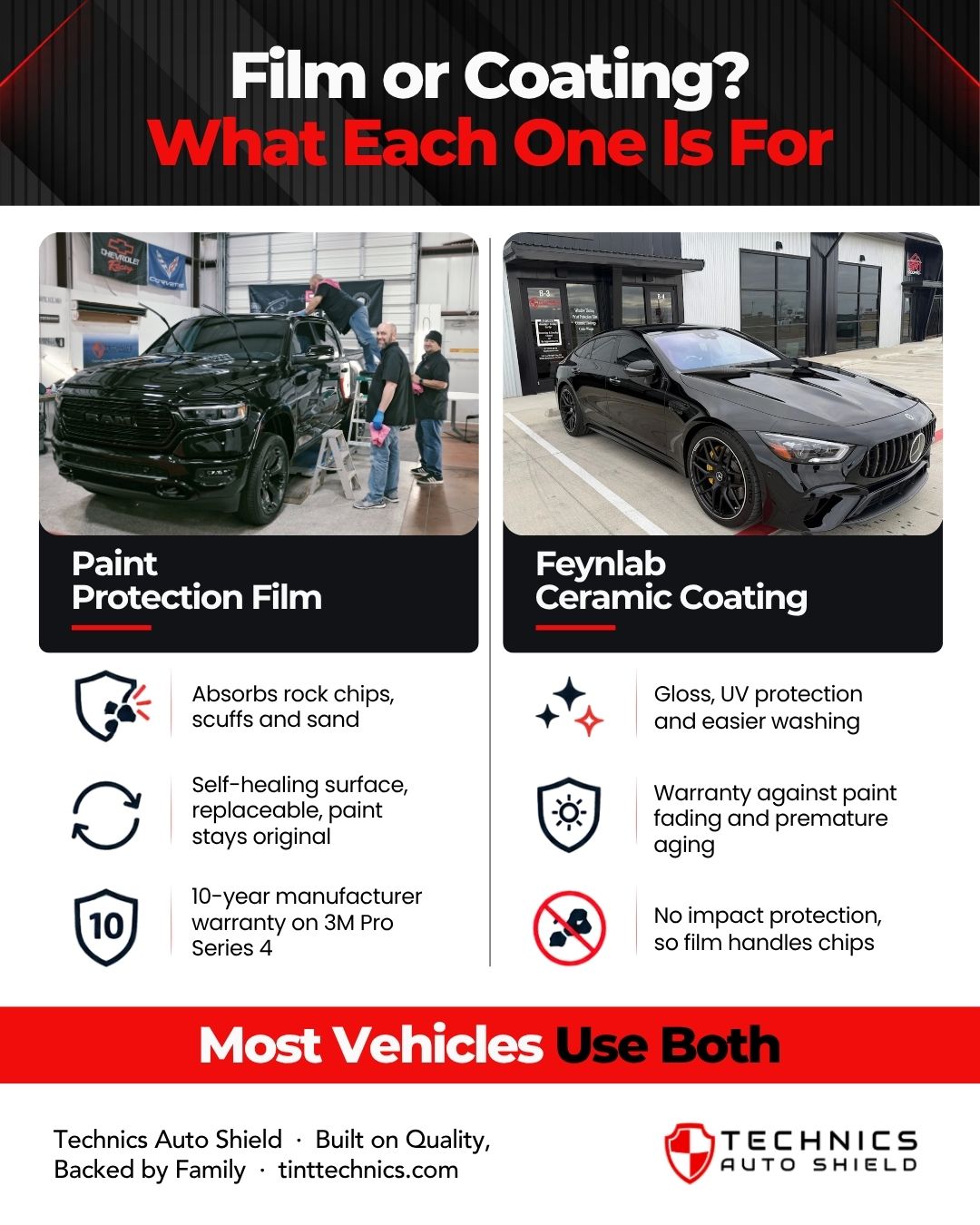
Paint protection film is a clear, flexible sheet applied over your vehicle’s painted panels. It’s thick enough to absorb the chips, scuffs and sand of everyday driving, and thin and clear enough that you don’t see it from a few feet away. It takes that damage instead of your paint, and when it has taken enough, it’s removed and replaced while your factory paint stays original underneath. That’s why we call it sacrificial armor. What it doesn’t do is make a vehicle damage-proof, and any shop that tells you otherwise is setting you up for a disappointing conversation later.
That honest version is the one we give every client who walks into our shop in White Settlement, and it’s the version that tends to make people comfortable. Here’s what film really takes for you, where a Feynlab coating picks up, and what a careful install looks like from the moment your keys hit the counter.
Your paint doesn’t take the hit. The film does.
If paint protection film is new to you, here’s the physical reality of it. It’s a clear urethane sheet, roughly the thickness of a business card, cut to the exact shape of each panel on your vehicle and applied directly over the paint. It goes on wet, gets squeegeed down, and bonds as it dries. From a few feet away you can’t tell it’s there. The color you see is still your paint.
You’ll see it called a few things: paint protection film, PPF, or clear bra, a name left over from when it covered only the front of the hood. Same product.
What it’s for is the part worth understanding. The hood and bumper of your vehicle collect the marks of everything you drive through: grit thrown up by the truck ahead, bug residue baked on by the sun, sand on a county road, the brush of a bag against a fender in a parking lot. Factory paint takes all of that directly, and the clear coat on top of it is thin. Once it’s chipped, the repair is paint work.
Put film over that paint and the order changes. The film takes the hit first. It’s tough, it flexes instead of cracking, and years later it comes off and a fresh sheet goes on without disturbing what’s underneath. The paint you’re protecting is still the paint the factory sprayed, which matters whether you’re keeping the vehicle, selling it, or handing a lease back without a conversation about reconditioning.
That’s the reasoning behind the term sacrificial armor. A shield implies nothing gets through. Sacrificial means the film is absorbing damage on purpose, as the part of the system designed to be used up and swapped out. A client who understands that is pleased when the film shows a mark, because the mark was headed for the paint. A client who was sold a force field is disappointed by the same mark. We’d rather set the first expectation.
What hits a daily driver, and what film absorbs
The damage is small, repeated and cumulative, which is why people rarely notice it until they see the hood in direct sun. Here’s what film takes day to day:
- Road debris: Small stones and grit thrown up at highway speed, which is why the leading edge of the hood, the mirrors and the bumper collect the most marks.
- Sand and abrasion: Dust and sand act like fine sandpaper over time, dulling the leading surfaces first.
- Bug residue and road grime: Both are acidic enough to etch a clear coat when they bake on. Film gives you a surface that cleans up without that risk to the paint.
- Everyday contact: Door edges, door handles and rocker panels pick up scuffs from rings, keys, shoes and the car parked a little too close.
Our full body coverage protects exactly those high-impact areas: hood, fenders, mirrors, bumpers, lights, rocker panels, door edges and door handles. The front-focused packages concentrate on where debris lands first. Either way, the film is doing the absorbing and the paint is staying out of it.
What film does not do, in plain terms
Most shops skip this part. We think it’s why people trust us.
Film does not make a vehicle damage-proof. A large rock at highway speed can mark the film and, in a bad case, the paint under it. It won’t prevent a collision, a cart strike or a deep gouge from something sharp.
Film also isn’t permanent. It’s a wear item, like tires. It works for years, and when it has absorbed enough, it comes off and a fresh layer goes on.
And film isn’t what makes a whole vehicle glossy and quick to wash. That’s a coating, which is the next section.
None of that makes film a weaker purchase. It makes it a clear one: a replaceable layer that takes the small, constant damage so your original paint doesn’t.
How self-healing works, without the magic
“Self-healing” sounds like marketing until you watch it happen. The 3M Pro Series 4 film we install has a top layer engineered to return to its original shape when it warms up. Fine swirls and light surface scratches, the kind a towel or a car wash brush leaves, relax back out of the surface with heat. A hot day in a parking lot does it. So does warm water.
What it won’t do is close a deep cut or a tear. Anything that goes through the top layer stays. That’s the honest boundary, and it’s the same boundary the material itself has.
For an owner, self-healing mostly shows up as a finish that keeps looking clean without you doing anything about it. The minor marks that would accumulate on paint simply don’t accumulate the same way on film.
Where a Feynlab coating fits beside film
We’re an Authorized Feynlab Installer, and a coating is the other half of how we protect a finish. It does a completely different job from film.
A ceramic coating is a liquid applied over your paint that cures into a hard, slick, water-repellent layer. It helps protect against UV fading and premature aging under the Texas sun, it holds gloss, and it makes washing faster because water, dirt and grime release instead of clinging. Every Feynlab package we install carries a Feynlab warranty against paint fading and premature aging.
What a coating does not do is stop rock chips. There’s no impact protection in a coating, and we say that to every client who asks. If chips are the concern, that’s film.
Our three Feynlab options build from there:
- Feynlab Ceramic V3 carries a 3-year warranty, with a hydrophobic, easy-clean finish plus UV protection and gloss.
- Feynlab Ultra V3 carries a 5-year warranty with a longer-lasting, ultra-hydrophobic finish.
- Feynlab Ceramic Plus carries a 5-year warranty and is our heaviest coating, a base coat with a top coat over it.
The pairing we’re asked for most often is simple: film on the front end where debris lands, a Feynlab coating over the whole vehicle for gloss, UV protection and easier washing. Each product covers what the other doesn’t.
Choosing coverage by the way you drive
Coverage is a driving question, not a vehicle question. Two identical trucks need different packages if one commutes on the interstate and the other runs errands across town.
Highway miles: Paint protection film in our Highway package covers the first 15 to 24 inches of the hood along with the mirrors and front bumper. That’s the strike zone for anything the vehicle ahead of you throws, and it’s the package built for commuters and road trips.
A vehicle you plan to keep: The Front Clip package covers the entire front end: the whole hood, both front fenders, the mirrors and the front bumper. There’s no film line across the middle of the hood, and the whole front of the vehicle keeps its original finish.
Something you’d hate to touch up: Full body coverage extends to the high-impact and high-touch areas across the vehicle, including rocker panels, door edges, and door handles, which is where everyday contact shows up on a car you otherwise keep perfect.
We’d rather talk you into the right package than the biggest one. If a front-focused package fits how you actually drive, that’s what we’ll recommend, and you can always add coverage later.
When film isn’t the right answer
We’d rather send you home with the right plan than the biggest invoice, and sometimes the right plan is less film.
If you’re selling or trading a vehicle in the next few months, full body coverage probably isn’t where your money does the most good. A front-focused package protects the part that takes the damage and leaves you something to point at in the listing.
If the paint has already been through years of sun and automatic washes, correction and a Feynlab coating may give you more of the look you’re after than film would. Film preserves what’s there. It doesn’t restore what’s gone.
And if the vehicle is a work truck that spends its life on gravel and job sites, we’ll talk honestly about how often the film will need replacing, so the plan matches the way the truck actually lives.
What doesn’t change is the standard. A Highway package gets the same preparation, the same handwork and the same final inspection as a full body job.
The part that decides everything: preparation
One thing separates an install that lasts from one that doesn’t, and it has nothing to do with the film itself. Both shops can buy the same roll. What they can’t both buy is the hour or two before it goes on.
Film bonds to whatever is on the surface. Wax, road film, iron particles, a speck of dust: anything still there when the film goes down is sealed in, visible, and permanent until the film comes off. So preparation isn’t a step we rush.
On paint, that means a wash that strips old waxes and sealants, removal of bonded contaminants, and a clay treatment to pull out whatever the wash leaves behind. Coating and correction work start the same way.
It also means a real look at the paint first. Film and a coating will both lock in swirl marks exactly as they are, so this is the moment to decide whether correction belongs in the plan.
Nobody takes a photo of the prep stage. It’s the stage that determines how the finished job looks in two years.
Correction levels, explained simply
Paint correction is machine polishing that levels the clear coat so light reflects evenly again. We offer three levels, and the right one depends on what’s actually in your paint.
- Gloss enhancement polish: One pass that lifts gloss and clears the lightest swirls. For newer paint that just needs its depth back.
- One stage correction: Removes swirl marks and light scratches, then finishes with a polish for a deep, glossy result.
- Two stage correction: A heavier cut for deeper defects, followed by a series of fine polishes to refine the finish.
Correction also clears marks people assume are permanent: etching from bird droppings or acid rain, buffer trails and the hazy pattern a previous polisher left behind. Isolated deep scratches can sometimes be improved, depending on how deep they go.
Doing correction before a coating is what makes the biggest visual difference, because the coating then locks in a corrected finish instead of a tired one.
Computer-cut patterns, finished by hand
Patterns are cut by machine for your exact vehicle, which gets the shape right before anything touches the paint. Everything after that is handwork: fitting the piece, working it into the contours of the panel, finishing every edge.
Edges are where an install shows its quality. Every piece of film has one, and an edge is where dirt, water and wind try to get underneath. On a careful install, edges are tucked around the panel wherever the body allows and finished tight to the paint where it doesn’t. Done right, you have to look for them.
Seams follow the same logic. When a panel is too large or too curved for a single piece, the seam goes along a natural body line where the eye already expects a break, rather than across the middle of a hood.
Then we inspect under good light before the keys go back, because the time to find something is while the vehicle is still in our bay.
Why we hand cut window film
Glass comes up on almost every build, so here’s the short version.
We install three 3M automotive films. Crystalline is the one to ask about when you want the cabin noticeably cooler without going dark. Ceramic IR gives you comfort with a darker, more private look. Obsidian is our traditional film, with a clean dark finish and solid everyday performance. All three carry a lifetime nationwide warranty, void only if the film is layered over another film.
The part that surprises people is how we cut it. We’re one of very few shops that hand cut window film. Most shops use cutting software and a plotter, which is quick and works fine for vehicles already in the database. Hand cutting means we can tint vehicles that aren’t in that database at all, classic cars included. If you’ve been told your car can’t be done because there’s no pattern for it, that’s a software limit, not a tinting limit.
We’ll also tell you up front how Texas rules apply to your vehicle. Front side windows have to let through at least 25 percent of light, and a clear film can cover the full windshield as long as the film and glass together still pass 70 percent.
Film underneath a wrap, and other combinations
A wrap changes the color or finish of a vehicle without touching the factory paint, as a full wrap, a partial wrap, or custom stripes and graphics, including matte black and carbon fiber. It’s removable, it carries a manufacturer warranty, and it protects the paint from UV while it’s on. For a business, the same work turns a truck or van into branding that’s visible every day it’s on the road.
Here’s the combination people don’t expect from a film shop: paint protection film underneath a wrap. Vinyl is thinner than protective film and takes the same road debris your paint would, so film underneath gives the front end real impact protection while the wrap does the visual work. Both layers come off when you’re done, and the paint is still original.
It isn’t right for every build. If the vehicle rarely leaves town, the wrap alone may be plenty, and we’ll say so.
Other pairings clients ask about:
- Correction first, then a Feynlab coating, so the coating locks in a corrected finish.
- Film on the front end, with a coating over the whole vehicle for gloss and easier washing.
- A color change wrap with window film, so the vehicle looks different and the cabin stays cooler.
- Mobile detailing afterward to keep the whole package looking like pickup day.
What happens on install day
For a first-time client, the unknown part isn’t the product. It’s the day itself.
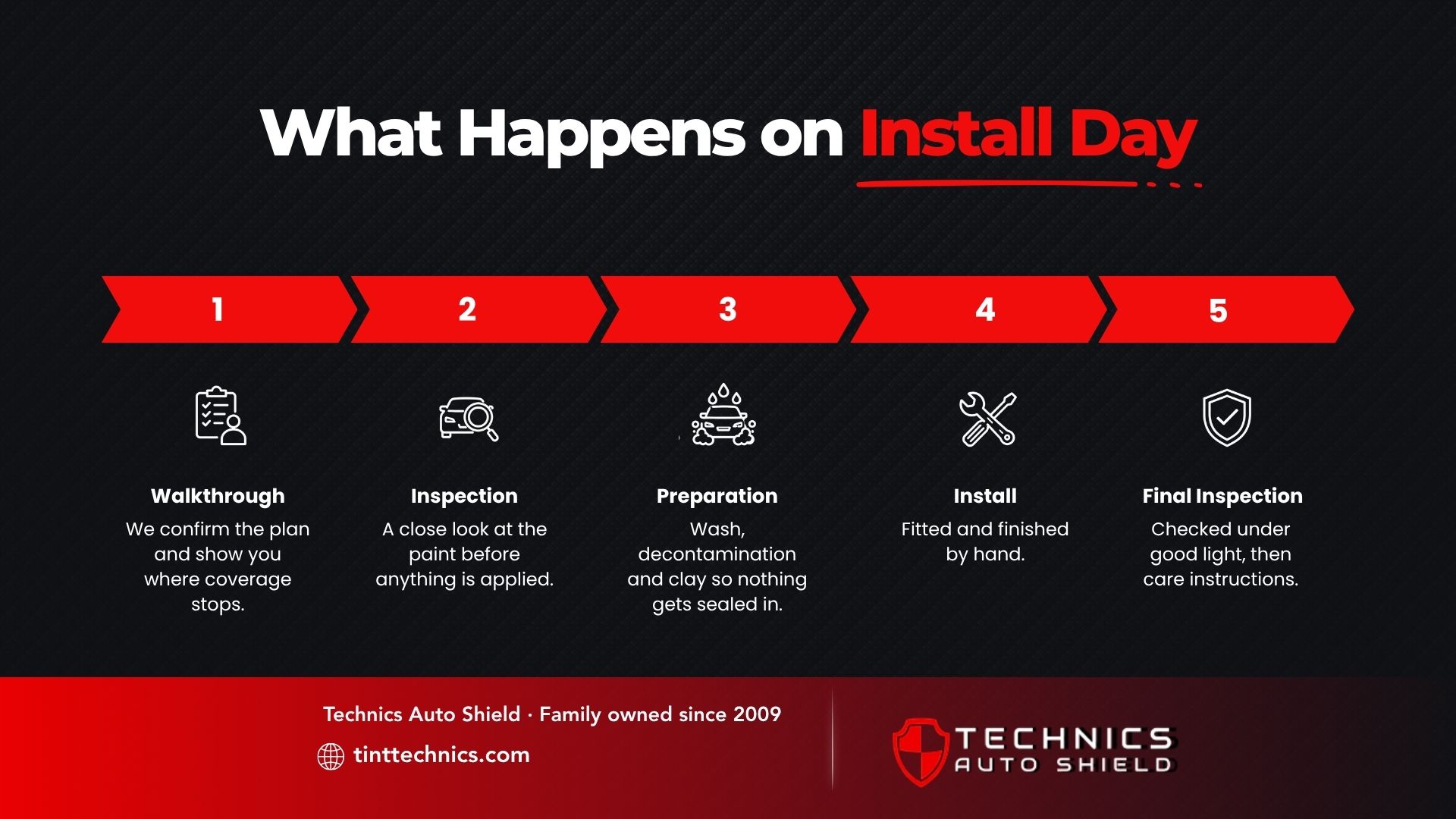
You drop the vehicle off, and we walk around it together. We confirm what’s being installed, show you exactly where coverage stops on each panel, and point out anything we noticed in the paint. If a chip should be addressed before film covers it, you hear about it then, not after.
Then the vehicle comes inside and preparation happens first. Patterns get cut for your specific vehicle, and the install is deliberate handwork: fitting, working the material into the panel, finishing the edges. Coating work runs on its own clock, a day and a half to three days depending on the package, because the surface has to be prepared properly and the coating needs time to cure.
Before your keys come back, every vehicle gets the same inspection under good light. We check that edges sit tight with nothing lifting at handles or mirror caps, that nothing is trapped underneath, that any seams follow a body line, and that coverage matches exactly what the quote described. Anything that isn’t right gets handled while the vehicle is still ours.
Then we walk it with you and send you off with care instructions for what was installed.
Caring for it afterward
Good aftercare is simple, and it’s a big part of why a careful install still looks right years later.
After a coating
Wait seven days before the first wash so the coating fully cures. After that, use touchless washes. Traditional brush washes can void the warranty, which is worth knowing before you pull into the quick wash down the street out of habit. A coated finish releases dirt easily, so a touchless wash does more than it would on uncoated paint.
After film
Hand washing with a pH-neutral soap and clean microfiber is the easiest way to keep film at its best. If you use a pressure washer, keep the nozzle back from the film edges. Light swirls in the top layer will relax out with heat on their own.
After window film
Give new film time to cure before rolling the windows down, and we’ll tell you how long for your vehicle and the weather that week. After that, clean the glass with a soft microfiber towel and a cleaner that’s safe for tinted windows.
After a wrap
Treat a wrap much like paint: hand wash, skip harsh chemicals and brushes, and deal with bird droppings and bug residue promptly. Matte finishes want a little extra care, and we’ll walk you through it for your specific wrap.
If you’d rather not handle upkeep yourself, our mobile detailing comes to you and covers both interior and exterior care.
What film looks like a few years in
Film is a wear item, and knowing how it ages makes it easier to plan for.
A well-installed, well-cared-for film keeps doing its job quietly for years. The surface stays clear, light marks keep relaxing out with heat, and the paint underneath stays exactly as it was the day the film went on. The 3M Pro Series 4 film we install carries a 10-year manufacturer warranty, which is the manufacturer’s statement about how long the material is built to perform.
Eventually a panel’s film has absorbed enough, usually the leading edge of a hood or a bumper that’s been doing the most work. At that point the film comes off and fresh film goes on. The job is cheaper and simpler than paint work, and that’s the whole point of sacrificial armor: you’re replacing a layer instead of refinishing a panel.
When you’re ready for that, bring it back and we’ll handle it. The paint underneath is still the original, which is exactly where we wanted it to be.
This isn’t theory. It’s a regular part of our week, and clients tell the story better than we do:
“Love this technics. Auto shield. They replaced the PPF on the front hood of my 2014 Toyota 4Runner. They were fast, friendly and extremely reasonable. I have every intention to use them for both of my vehicles in the very near future.”
- Travis, Google review
“Did a great job replacing old factory PPF on a forerunner! Have used them for all of my vehicles.”
- Dustin Anderson, Google review
A hood’s worth of film had absorbed years of road debris, it came off, fresh film went on, and the paint underneath went right back to work. That’s the system doing exactly what it’s designed to do.
Questions we hear in the shop
“Can you see it?” From a normal viewing distance, no. The film is clear and the color you see is your paint. Up close you can find the edges if you know where to look, which is exactly where a careful install earns its keep.
“Do I have to do everything at once?” Not at all. Plenty of clients start with the front end and add coverage or a coating later, and we keep notes on what’s already on your vehicle.
The aviation side, and what it taught us
We also work on aircraft, and that work shapes how we approach everything else.
For airplane tint, we install a film made for acrylic aircraft windows that rejects up to 92% of infrared heat and blocks up to 99% of UV rays, on private planes, turboprops, corporate jets and helicopters. The result is a cooler cabin, less glare and less sun reaching the interior. We also apply aviation ceramic coating to aircraft paint and finishes, and we can work on-site at hangars and airports.
Aircraft work runs on a documented process: inspection, preparation, application, curing and a final inspection, the same five steps every time. There’s no room for improvising on an aircraft, and once that process becomes habit, it doesn’t switch off when a daily driver rolls into the bay.
Keeping it looking that way: mobile detailing
Protection is half of keeping a vehicle sharp. Upkeep is the other half, and it’s the part that slides when a week gets busy.
Our mobile detailing comes to you, wherever the vehicle is parked. Outside, that’s a thorough clean, polish and protective treatment. Inside, a deep clean of carpets, upholstery and surfaces. For a vehicle that already has film, a coating or a wrap on it, the people maintaining the finish are the same people who installed it, so nothing goes on the paint that shouldn’t.
Who you’re trusting with the keys
Technics Auto Shield has been family owned and operated since 2009, with more than 25 years of film experience behind the work. The family that owns the shop runs it day to day alongside our shop foreman, and the people who own the place are the people who answer for the job.
On the credential side, we’re a 3M Pro Shop Dealer, a 3M certified Crystalline installer and an Authorized Feynlab Installer, and we earned 3M Pro Shop Dealer Excellence awards in 2021 and 2023. Those matter in a practical way: the products on your vehicle are ones the manufacturers trained us to install, and your manufacturer warranty gets registered.
Our motto is “Built on Quality, Backed by Family,” and the second half is the part that’s hard to copy. There’s no regional office to call. If something needs attention after your install, you’re talking to the family whose name is on the business.
What our clients say
We’d rather let clients describe the work. Technics Auto Shield holds a 5.0-star rating across 489 Google reviews. A few of them:
“Drove several hours for work on my 2024 Chevy Tahoe Z71 and it was absolutely worth it. Outstanding service from the owners and the whole team! professional, friendly, and they treat your vehicle like their own. Quality work and they stand behind it. Look no further if you need tint, PPF, or ceramic coating. Highly recommend Technics Auto Shield!”
- Noel, Google review
“I did my shopping and am so glad I landed with Corey and Amanda at Technics Auto Shield. Their 5 Star Reviews say it all.. they’re professional, the work is awesome, they’re friendly, and fairly priced. The results on my black 2026 4Runner TRD Pro are stunning, plus I have a list of tips to keep it that way for years to come. Suffice it to say I could not recommend them higher… I’d give them 10 Stars if I could.”
- Bob Schultz, Google review
“The window tinting on my 2026 F150 XLT was completed as scheduled and the work done was exceptional….. very professional. I like that!”
- Alberto H. Moreno, Google review
“My husband and I have used Technics Auto Shield for many years on all of our company and personal vehicles. They are always professional and reasonably priced. Highly recommended.”
- Tina Cundiff, Google review
The phrase in Bob’s review that we’re proudest of is the one about tips to keep it that way. That’s the walkthrough at pickup doing its job.
Where we work
Our shop sits at 700 N. Jim Wright Fwy #B3 in White Settlement, just west of downtown Fort Worth, which puts us minutes from Benbrook, Westworth and Westover Hills, an easy drive from Lakeside and Eagle Mountain, and a straight shot east on the interstate from Aledo and Brock.
Clients also come to us from across the rest of Tarrant County, including Fort Worth, Azle, Saginaw, Keller, Southlake, Colleyville, Grapevine, Watauga, Haltom City, Richland Hills, Hurst, Bedford, Euless, Arlington, Grand Prairie, Mansfield, Burleson, Crowley and Forest Hill. Mobile detailing comes to you, and aircraft owners across DFW can reach us about on-site work at hangars and airports.
Final thought
Protective film is one of the few products that’s easier to trust once you know its limits. It absorbs the small, constant damage that quietly ages a finish, it can be replaced when it’s done its job, and it leaves your original paint exactly where it started. A Feynlab coating handles the gloss, the UV and the easier washes. Together they cover a vehicle properly, and neither one has to be oversold to be worth it.
If you want a straight answer about what your vehicle actually needs, we’re glad to give you one. Request a free quote at tinttechnics.com or call us at (817) 571-8468.
