

Paint Correction in Westworth Village, TX
Most paint correction jobs are about swirl marks. A fair number of the ones that come to us from Westworth Village are about something else: paint that has been standing still.
A car parked outside for six months does not collect scratches. It collects oxidation, bonded contamination and water etching, and those need different work than buffing out wash marks. Coming back to a car that looks dull and chalky is not a sign the paint is ruined. In most cases the colour is still under there.
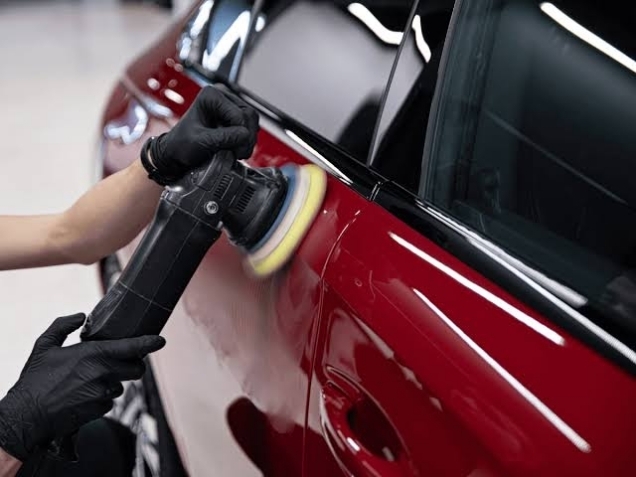
What sitting outside actually does to paint
Three separate things happen, and they stack.
Oxidation. UV breaks down the top of the clear coat. The surface goes microscopically rough, which scatters light instead of reflecting it, so the colour reads flat and chalky. This is the one that looks worst and is often the easiest to fix, because the damage is shallow.
Bonded contamination. Iron particles, rail dust and industrial fallout embed in the clear coat. You can feel it as roughness through a plastic bag over your hand. No amount of washing removes it.
Etching. Bird droppings, sap and hard water that sat through a Texas summer eat a physical crater into the clear coat. This is the deepest of the three and the one that decides which correction step you need.
Our steps and what each one removes
Every correction we do starts with a paint prep wash that strips existing waxes and sealants, removes iron deposits and clay bars the surface. That is included, not an add-on, and on a car that has sat it often accounts for a visible part of the improvement on its own.
Gloss enhancement polish, $525. Lifts gloss and takes out the lightest marring. On a lot of returned-from-storage cars, this plus the prep wash is the whole job.
One stage correction, $675. Removes swirl marks and light scratches using Americana Global 1500 leveling compound, finished with Finesse Polish. The right call where oxidation has gone beyond the very top of the clear coat.
Two stage correction, $825. Deep defect removal with an aggressive microfiber cutting pad and a leveling compound, then a series of ultra-fine polishes. This is for etching and heavier damage.
We assess the paint and tell you the lowest step that will actually work. Correction removes clear coat, and there is a finite amount of it on any car, so doing more than the paint needs is not thoroughness. It is waste.

Sequence it with the coating
If the plan is correction plus a ceramic coating, do them in that order and close together. Corrected paint is bare and unprotected, so leaving it for weeks before coating gives it time to pick up new contamination that has to be removed again.
If you are heading out again and want the car protected while you are gone, correct and coat before you leave rather than after you get back. The correction is cheaper on paint that has not just spent six months oxidising.
Questions we get from Westworth Village
My car looks chalky after months outside. Is the paint ruined?
Almost never. Chalky usually means oxidation in the top few microns of clear coat, which is exactly what correction removes. The colour underneath is generally intact. What we cannot fix by polishing is damage that has gone through the clear coat into the base colour, and that is far rarer than it looks.
How many times can a car be corrected?
Clear coat is finite, and each correction removes a little. A car can take several light corrections over its life without trouble. Repeated aggressive three step work on the same panels is what causes problems. This is the main reason we recommend the lowest effective step rather than the heaviest one.
Can you fix a deep scratch?
Sometimes. If your fingernail catches in it, it has gone through the clear coat and polishing will not remove it, though it can soften how visible it is. Isolated deep scratches are assessed individually rather than quoted blind.
What our customers say


Booking From Westworth Village
700 N. Jim Wright Fwy, Bldg. B, Ste. 3, White Settlement, TX 76108. About 14 minutes via Loop 820 and I-30. Monday to Friday, 9 to 5.
Correction is not a wait-in-the-lobby job. Tell us the vehicle and roughly how long it has been standing, and we will tell you which step it needs before you drop it off.